Transport
Cost every leg of the journey, including fuel, from the vehicle you actually use.
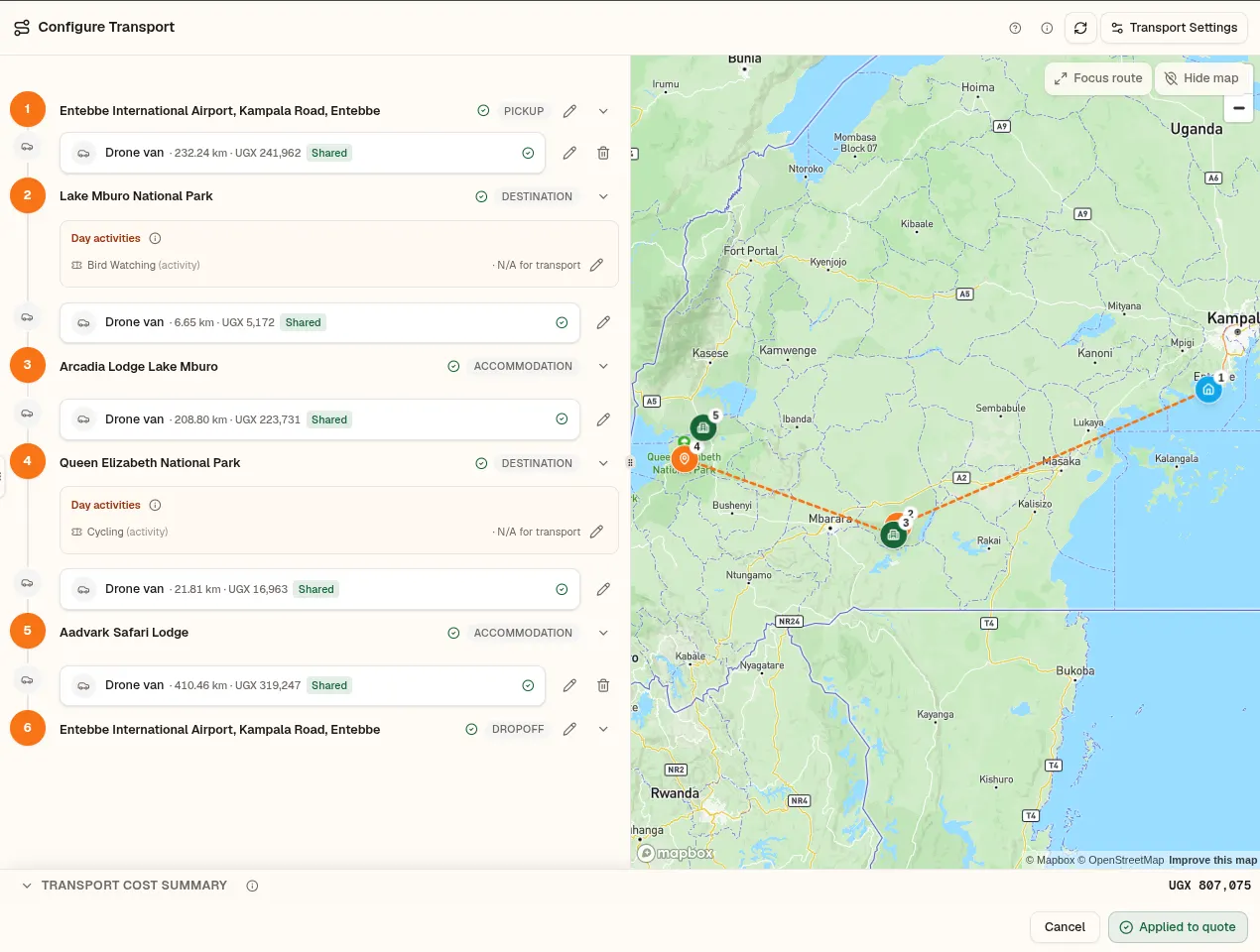
Configure transport for the whole trip: route legs, stopovers, day activities as waypoints, distance and fuel, with a map that matches your PDF.
What it does
Transport is usually the line operators estimate by gut feel. Quest models it properly. You choose a vehicle, and the route is built as legs between your stops. Activities in the itinerary appear as waypoints along a leg, so the distance reflects what the group will really drive.
Fuel is calculated from the vehicle's kilometres per litre and the pump price, converted at your exchange rate, and the full breakdown is shown so you can check it. Transport costs and the map are applied once the configuration is complete, so a half-finished route never leaks into a price.
Western Uganda operators often chain long transfers between Kasese, Queen Elizabeth, Bwindi and Entebbe. Modelling legs separately beats a single "USD 150 per day for fuel" line when a client asks why Tuesday's transfer costs more than Wednesday's game drives.
Why operators use it
- 01
Distance from the route, not a guess
Legs, stopovers and day activities combine into the distance and fuel for each leg.
- 02
Fuel you can explain
See the kilometres, the km per litre and the pump price behind every fuel figure.
- 03
A map that matches the PDF
The transport map in the app and in the tourist PDF use the same route.
How it works
Choose the vehicle
Set the primary vehicle, and a secondary one if the group needs it.
Configure the route
Review the legs and add stopovers or manual distances.
Apply and price
Apply the configuration and transport costs flow into the quote.
FAQ
Common questions about transport.
Fuel cost is the estimated kilometres divided by the vehicle's kilometres per litre, multiplied by the pump price per litre, converted into the quote currency at your exchange rate.